What is a völva? On the trail of the seers of the North
Who were the völur, the seers of the Viking Age? What the Völuspá, the sagas and archaeology tell us, and why their way of seeing without imposing inspires The Völva Way.
People often ask me why my work bears this name: The Völva Way, the way of the völva. The word sounds ancient, a little mysterious, and it is. It comes to us from the lands of the North, from a time when people would sometimes send far and wide for a woman able to see what others could not. Here is who these seers were, what the texts and archaeology tell us about them, and why their way of seeing without imposing resonates so strongly with my practice as a Seer & Oracle.
The völva, “the staff-bearer”
In Viking Age Scandinavia (roughly the 8th to the 11th century), the völva (plural völur) was a seer, a prophetess. Her name is generally linked to the Old Norse völr, the staff: the völva is literally “the one who carries the staff”. This staff, often described as ornate, was no simple walking stick. It was the emblem of her role, the tool that accompanied her crossing into the invisible.
The völva was not a priestess bound to a temple. The stories show her rather as a traveller: she was invited from farm to farm, received with the greatest honour, and consulted about harvests, winters, marriages and destinies. She was both respected and a little feared, for she stood on the threshold between two worlds.
What the ancient texts tell us
The Völuspá, the prophecy of the seeress
The most famous testimony is a poem: the Völuspá, “the prophecy of the seeress”, which opens the Poetic Edda, a collection of mythological poems preserved in a 13th-century Icelandic manuscript. Odin himself, the wisest of the gods, comes to question a völva. And it is she who speaks: she tells of the birth of the world, the great ash tree Yggdrasil, the fate of the gods and their twilight, and then the rebirth of a new, “ever-green” earth rising from the waters.
This detail is remarkable: in this founding story, knowledge of the past and the future belongs to a woman, and the most powerful of the gods must come and listen to her. The poem does not end with the end of the world, but with what is reborn after it. Death and rebirth: a theme that runs through all my work.
Þorbjörg, the “little völva” of Greenland
The most vivid description comes from the Saga of Erik the Red, a 13th-century Icelandic tale. A famine strikes a community in Greenland. The master of the farm sends for Þorbjörg, known as lítilvölva, “the little völva”, the only survivor of nine sisters, all of them seers.
The saga lingers on her attire, as if to state her rank: a dark blue cloak set with stones, a necklace of glass beads, a hood of black lambskin lined with white cat fur, catskin gloves, a pouch holding her objects of power and, of course, her staff. A high seat is prepared for her, with a cushion stuffed with hen feathers. She spends the night there, then prepares for the ritual of the following day.
For the spirits to come, a particular song is needed. Only one woman in the gathering knows it: Guðríðr, who learned it as a child. She sings so beautifully that the völva declares many spirits have drawn near, attracted by the beauty of her voice. Then Þorbjörg speaks: the famine will end with the spring. She turns to Guðríðr and foretells a bright destiny, a great marriage and a lineage from which a great light will be born.
The völva does not decide Guðríðr’s destiny. She sees it, she names it, and she entrusts it to her.
Seiðr, an art passed on by Freyja
The practice associated with the völur has a name: seiðr, a set of techniques of vision, trance and influence over the course of things. In Norse mythology, it is linked to the goddess Freyja. The Ynglinga Saga, written by the Icelander Snorri Sturluson, even tells that Freyja was the first to teach it to the gods. A feminine knowledge, then, passed from a goddess to the gods themselves.
What the earth has kept
The völur are not just a literary motif. In Scandinavia, archaeologists have uncovered graves of Viking Age women buried with metal staffs, often ornate, which many researchers interpret as seers’ staffs. In Denmark, at the site of Fyrkat, a 10th-century woman was buried with exceptional grave goods, including a small pouch containing henbane seeds, a plant with hallucinogenic properties. Everything suggests that she held a special place in her community.
These discoveries remind us that behind the sagas, there were real women, recognized for their gift and honoured even in death.
Seeing without imposing: the way I have chosen
For a long time, I used the word “medium”. Then, after a deep transformation, I understood that the true nature of my gifts no longer resonated with that term. What I do is see: perceive your best possible future, the one your soul longs to experience. In English, we say Seer, the one who sees. In the ancient North, they said völva.
There is, however, an essential difference, and I want to name it. In the sagas, prophecy often sounds like a sealed fate. For me, the future is never fixed. I do not alter it; I observe it. There is more than one possible future, and the one that comes to pass depends on the choices you make, in honor of your free will. My role is to show you the brightest path, then help you cross the bridge that brings you closer to it.
From the völva, I keep what touches me most:
- The threshold: standing between the visible and the invisible to bring back what helps us live.
- The staff: a support, an axis. Something that keeps you standing during the crossing.
- Guðríðr’s song: vision never happens alone. It is born of an encounter, of your intention and your openness.
- The earth reborn: after every ending, something greater can begin.
That is The Völva Way: an ancient way of looking at the future, in service of a life lived today. If you are going through a time of doubt, The Oracle helps you shed light on a specific area of your life. And if you feel the time has come to let go of what holds you back, The Elite Healings clear the blocks standing between you and your goal, one session at a time.
Further reading: the Völuspá and the Saga of Erik the Red are available in English, for instance in Carolyne Larrington’s translation of The Poetic Edda (Oxford World’s Classics) and in The Vinland Sagas (Penguin Classics).
What if this were your passage?
The Oracle or The Elite Healings: two remote sessions to move towards your best possible future.
Discover the sessions✦Read also
Predictions
November 2026 prediction: finance, love and career
As a Seer and Oracle, I have the ability to see possible futures—often the best possible future. On this blog, you will therefore find a prediction for the current month covering Finance, Love, and Career.
Predictions
October 2026 prediction: finance, love and career
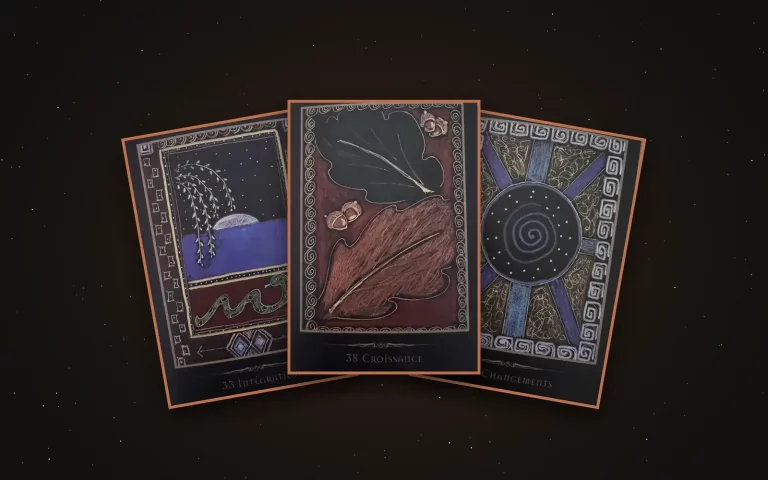
The October 2026 prediction by Océane Chartrey, Seer & Oracle: finance, career and love, plus the three oracle cards of the month.